

Best coffee beans for cold brew: Top pick 2026
Best overall: Philip & Philip Coffee Company’s Cold Brew Coffee. Best for milk: dark-roast beans. Best for fruit-forward experimentation: light-roast beans. This 2026 guide ranks the best coffee beans for cold brew by drinking style, flavor direction, and how easily you can dial in a batch.
- Philip & Philip Coffee Company’s Cold Brew Coffee is the best starting point for chocolate-and-toffee cold brew.
- Choose medium-roast coffee beans for a balanced black coffee; choose dark roast when you usually add milk.
- Choose light-roast beans for fruit-forward experiments, not as the simplest first batch.
- For cold brew, grind consistency and dilution deserve as much attention as the beans.
Why this matters
Cold brew is coffee extracted with cool water, not hot coffee poured over ice. That distinction changes your recipe and what you notice in the cup. A coffee you enjoy hot does not automatically become your favorite after a long cold steep.
The best beans are the ones that suit your finished drink—not the darkest bag on the shelf. If you drink cold brew black, flavor balance matters immediately. If you add milk, you need a coffee character that remains noticeable after dilution.
Philip & Philip Coffee Company’s Cold Brew Coffee is the best starting point here for drinkers seeking chocolate and toffee notes. Its supplied description identifies a medium roast with smooth chocolate, toffee, and floral tones, and explicitly recommends it for cold brew or nitro.
What makes the best coffee beans for cold brew in 2026?
Use these criteria before choosing a bag. They explain the ranking and give you a way to reject an unsuitable option without relying on a cold-brew label alone.
- Flavor direction: Match the stated tasting profile to what you enjoy. Chocolate, roast, and fruit are different destinations, not quality grades.
- Serving style: Judge the coffee black, with milk, or diluted over ice according to how you actually drink it.
- Grind control: Whole beans let you adjust the grind to your brewer. With ground coffee, confirm that the grind suits your filter.
- Extraction flexibility: Choose beans you can adjust through grind, steep time, and dilution rather than expecting a bag to fix every recipe.
- Clear product information: Prefer an explicit roast or tasting description over assumptions based on an origin name or attractive packaging.
Freshness belongs in the decision, too. Buy an amount you can use consistently, keep the coffee sealed, and avoid exposing the entire bag to heat and moisture while preparing each batch.
Best cold-brew beans at a glance
The first row is a named product. The remaining rows are buying categories, not individual products tested against it. Each occupies a different use-case slot.
| Rank | Coffee choice | Best for | Standout feature | Key limitation |
|---|---|---|---|---|
| 1 | Cold Brew Coffee | A straightforward first purchase | Supplied medium-roast profile lists chocolate, toffee, and floral tones | Not the first choice if you specifically want a strongly roast-led cup |
| 2 | Medium-roast single-origin beans | Black coffee drinkers comparing origins | Lets you explore a clearly described origin without defaulting to a dark roast | Origin alone does not tell you the finished flavor |
| 3 | Dark-roast beans | Cold brew served with milk | Roast-led flavors suit a drink built around milk | Can taste too bitter or smoky for drinkers seeking delicate flavors |
| 4 | Light-roast beans | Fruit-forward experimentation | Keeps the focus on lighter roast development and origin character | Usually demands more attention to extraction |
There is no universal roast winner. A balanced black coffee and a milk-heavy drink ask different things of the beans, so their best choices should differ.
1. Cold Brew Coffee: best for a straightforward first purchase
Philip & Philip Coffee Company’s Cold Brew Coffee gives you a specific flavor target: medium roast, smooth chocolate, toffee, and floral tones. The product description also names cold brew and nitro as intended uses. That makes it the clearest starting point in this selection.
The recommendation is about fit, not a promise that every batch tastes identical. Your grind, water, filter, and serving dilution still determine what reaches the glass. Start with the stated profile and adjust your preparation before deciding you need different beans.
Cold Brew Coffee pros:
- Explicitly described as suitable for cold brew or nitro.
- Medium roast gives you a defined starting point.
- Chocolate and toffee notes offer a clear flavor direction.
- Floral tones make the description more specific than simply saying smooth.
Cold Brew Coffee cons:
- The supplied description does not establish the grind format; confirm your selection before ordering.
- The medium-roast profile is not the same choice as a deliberately dark, roast-heavy coffee.
- A cold-brew-specific product still needs a suitable recipe and filtration.
Best for: Your first cold-brew purchase when chocolate and toffee sound more appealing than pronounced roast flavors or a fruit-led experiment.
Verdict: Buy Cold Brew Coffee for the clearest match between the stated profile and this brewing method.
Two cold-brew listings to inspect
Philip & Philip Coffee Company has two supplied Cold Brew Coffee listings. One explicitly describes the medium-roast chocolate, toffee, and floral profile; the other describes a blend specifically made for cold brew. Read the selected listing rather than assuming their descriptions are interchangeable.


2. Medium-roast single-origin beans: best for drinking black
Medium-roast single-origin beans are a useful next step when you want to compare coffees without milk obscuring the differences. Choose a bag with an explicit tasting description, then keep your recipe steady while you change the coffee.
Single origin identifies provenance, not a guaranteed flavor. Country names alone cannot establish acidity, sweetness, or body. Processing, roast development, and brewing all matter, so read the actual product information instead of assigning a taste to an entire country.
Medium-roast single-origin beans pros:
- Give black-coffee drinkers a focused way to compare origins.
- Let you select a stated flavor profile rather than a broad blend description.
- Provide an alternative to deliberately dark roast flavors.
Medium-roast single-origin beans cons:
- Medium roast is a broad description, not a standardized taste.
- A tasting profile described for hot brewing will not necessarily appear unchanged in cold brew.
- Switching beans and recipes together makes comparisons harder to interpret.
Best for: You drink cold brew black and want to learn which clearly described coffees you prefer.
For your 2026 buying shortlist, put the tasting description ahead of the origin's reputation. Keep the same water, grind setting, steep time, and dilution across comparisons; otherwise, you are comparing recipes as well as beans.
Verdict: Buy medium-roast single-origin beans for controlled black-coffee comparisons.
3. Dark-roast beans: best for cold brew with milk
Dark-roast beans suit drinkers who want roast-led flavors in a finished drink containing milk. Darker roasting shifts the flavor emphasis toward roast character, making this a different choice from a medium coffee selected for floral notes.
Do not confuse stronger roast flavor with greater caffeine content or better extraction. Those are separate questions. Choose dark roast because you like its taste, then set the concentration to suit the amount of milk you add.
Dark-roast beans pros:
- Offer a clear roast-led flavor direction.
- Suit drinkers who already enjoy darker coffee with milk.
- Make a useful contrast to lighter, origin-focused choices.
Dark-roast beans cons:
- Bitter or smoky notes can dominate when you drink the coffee black.
- Dark roast is not a reliable shortcut to higher caffeine.
- Extra steeping cannot correct a roast flavor you dislike.
Best for: Your usual cold brew includes milk, and you want the coffee's roast character to remain part of the drink.
Taste the coffee with your normal milk addition before making a judgment. A concentrate that seems excessive on its own is not the same drink as its diluted serving—but milk should not be used to rescue beans whose flavor you fundamentally dislike.
Verdict: Buy dark-roast beans for milk-based cold brew; skip them if smoky roast notes are your main complaint.
4. Light-roast beans: best for fruit-forward experiments
Light-roast beans are the exploratory option. Look for an explicit fruit or floral tasting description rather than assuming every light roast tastes fruity. Lighter roast development can preserve origin character, but your cold extraction must still draw out enough flavor.
This category is not the simplest default for a first batch. If the coffee tastes thin or sharply sour, assess extraction before rejecting the beans. Keep your changes controlled so you can tell what improved the cup.
Light-roast beans pros:
- Offer a route away from pronounced dark-roast flavors.
- Suit drinkers interested in explicitly described fruit and floral notes.
- Encourage comparisons between cold and hot preparations of the same coffee.
Light-roast beans cons:
- Cold extraction can require more adjustment to produce a balanced cup.
- Delicate flavors can become harder to distinguish after substantial dilution.
- A light-roast label alone does not establish a fruity profile.
Best for: You already enjoy lighter coffee and are willing to adjust your cold-brew recipe.
Keep your first trial small. Taste it black before adding milk, and compare it at more than one dilution. That separates a concentration problem from a flavor preference without requiring another bag.
Verdict: Hold light-roast beans for a deliberate experiment rather than making them your automatic first purchase.
A repeatable cold-brew starting recipe
For your first 2026 batch, use a measured recipe rather than filling a jar by eye. The following is a starting point to adjust, not a claim that every coffee needs identical extraction.
- Weigh coffee: Use 100 g of coffee with a coarse, reasonably consistent grind.
- Add water: Add 800 g of drinking water for a 1:8 coffee-to-water ratio by weight.
- Refrigerate: Cover the brewer and start with an 18-hour refrigerated steep.
- Filter: Separate the grounds, then use a paper filter if you want less sediment.
- Taste and dilute: Taste a small serving and add water or milk gradually.
A coarse grind helps manage filtration, but visibly uneven grounds still complicate extraction. Mix the grounds and water enough to wet the coffee, and use clean equipment throughout preparation.
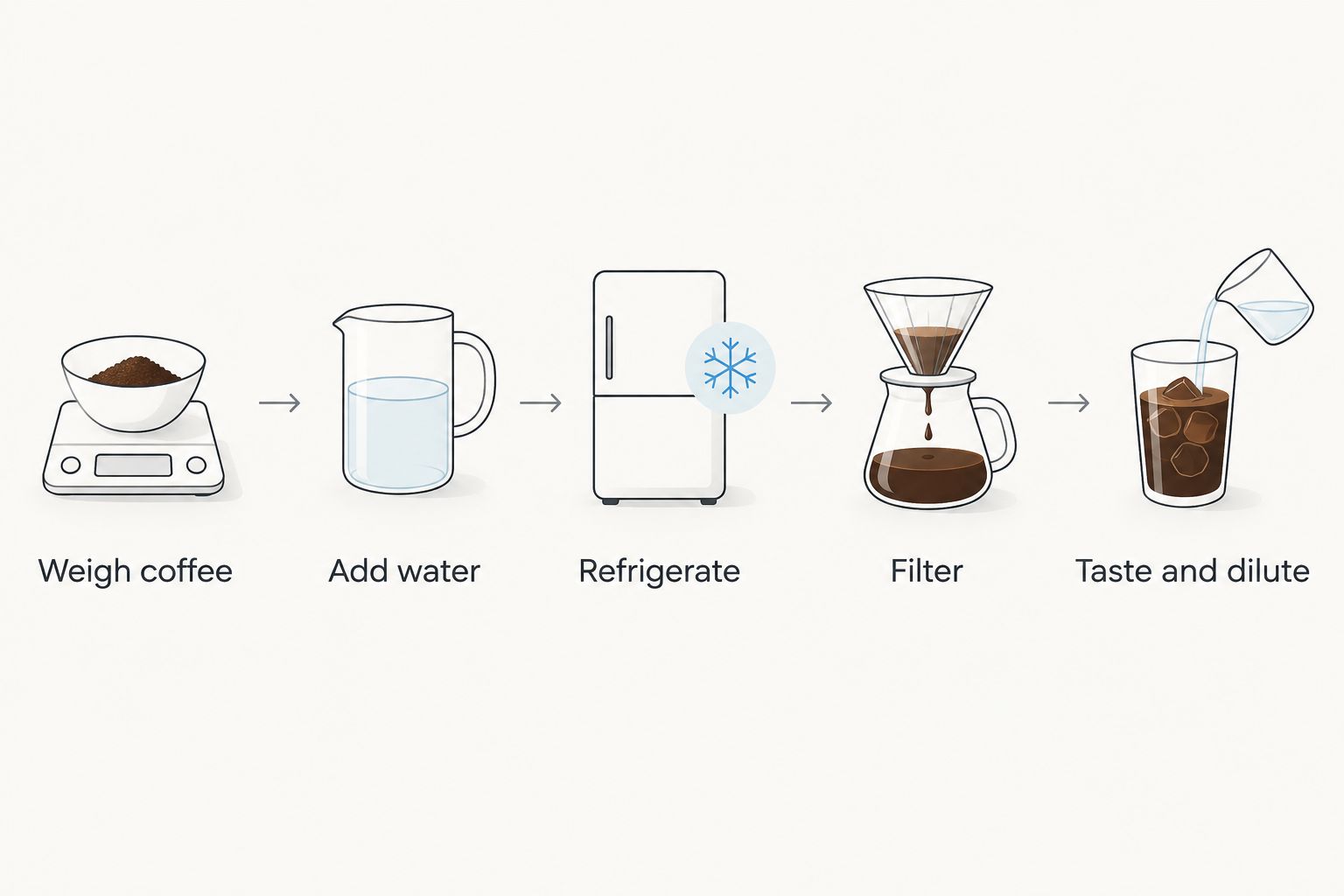
Record your grind setting, steep duration, and serving dilution. If a batch tastes too strong but otherwise pleasant, adjust dilution first; extending or shortening extraction solves a different problem.
If the coffee tastes thin, change one extraction variable on the next batch. If it contains gritty sediment, improve filtration before blaming the beans. Change one thing at a time, or the result cannot tell you which adjustment helped.
How the choices are ranked
This 2026 ranking prioritizes explicit product information, fit for the finished drink, and ease of selecting a useful starting point. It is a buying guide, not a laboratory comparison or a claim of blind tasting.
The named cold-brew product comes first because its supplied description directly matches the brewing method and identifies its flavor profile. The other choices separate black-coffee comparison, milk-based drinks, and lighter-roast experimentation into distinct decisions.
Which coffee beans should you choose?
Choose Philip & Philip Coffee Company’s Cold Brew Coffee if you want the default recommendation. Its stated medium-roast chocolate-and-toffee direction gives you a specific target without requiring you to infer flavor from an origin name.
Choose dark roast when milk is central to your drink. Choose medium-roast single-origin beans when you want to compare black coffees, and choose light roast when experimenting is part of the appeal. None of those preferences requires a universal winner.
FAQ
What's the best coffee for my first cold brew?
Philip & Philip Coffee Company’s Cold Brew Coffee is the default recommendation in this guide. Its supplied description identifies a medium roast with chocolate, toffee, and floral tones and explicitly recommends cold brew or nitro.
Are dark-roast beans better than medium roast for cold brew?
Dark roast is better suited to this guide's milk-based use case, not automatically better for all cold brew. Choose medium roast when you prefer its stated flavor profile and plan to assess the coffee black.
Can I use regular coffee beans for cold brew?
Yes, regular coffee beans can make cold brew. A cold-brew-specific label is not required; the beans, grind, extraction, and dilution need to suit your taste and brewer.
Should I buy whole beans or ground coffee for cold brew?
Choose whole beans when you have a grinder and want control over the grind. Ground coffee is a practical alternative when its grind suits your brewing and filtration setup.
What coffee-to-water ratio should I start with?
Start with 100 g of coffee and 800 g of water, a 1:8 ratio by weight. Treat this as an adjustable starting recipe, then dilute the finished coffee to suit your serving style.
How long should I steep my first refrigerated batch?
Start with an 18-hour refrigerated steep for the recipe in this guide. Evaluate the finished drink and change one extraction variable at a time rather than assuming longer always tastes better.
Is cold brew the same as iced coffee?
No, cold brew extracts coffee using cool water, while iced coffee can be brewed hot and then chilled. The different preparation methods need different recipes even when you use the same beans.
Will dark-roast cold brew always have more caffeine?
No, dark roast does not guarantee more caffeine in your serving. Coffee dose, extraction, and dilution also affect the finished drink, so roast color alone cannot answer that question.
One last thing
Before replacing a disappointing bag in 2026, taste the same filtered batch at different dilutions. Strength and flavor preference are not identical: a concentrated cup can conceal the balance you enjoy after adding water.
Fix dilution before buying new beans when the flavor is pleasant but the drink is simply too intense. That small check makes your next purchase a decision about coffee, not an attempt to correct the serving recipe.